Why Weapons Training Creates Hidden Liability Exposure Your Martial Arts Policy May Not Cover
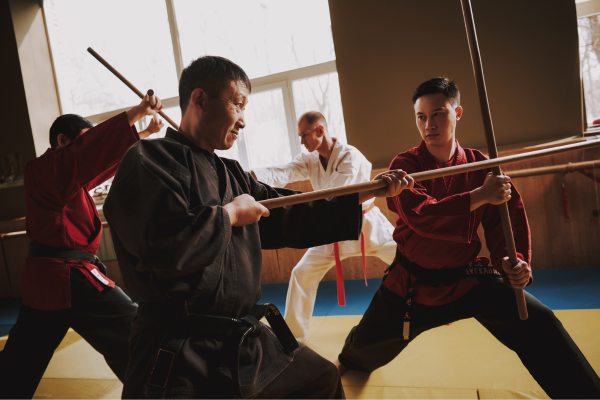
Many traditional martial arts schools incorporate weapons training into their advanced curriculum. Bo staff forms, nunchaku drills, kali stick fighting, wooden sword kata, and sai techniques are deeply embedded in arts like karate, kung fu, taekwondo, and Filipino martial arts. Students love weapons training. Parents are impressed by demonstrations. Tournaments award medals for weapon forms.
But weapons introduce a liability dimension that empty-hand training simply does not carry. A misjudged distance during partner drills becomes a facial fracture instead of a bruise. A bo staff released during a spinning technique becomes a projectile in a room full of spectators. A nunchaku rebounds unpredictably during a beginner’s first attempt.
Understanding how weapons training affects your insurance coverage and whether your current policy actually addresses this exposure is essential for any school teaching armed disciplines.
Why Weapons Training Amplifies Liability Beyond Empty Hand Arts
Increased Severity of Injuries
Empty-hand martial arts injuries tend toward sprains, strains, and bruising. Weapons multiply the force and concentration of impact dramatically. A wooden bo staff striking a face, a tonfa making contact with a hand, or an errant sword strike produces lacerations, fractures, eye injuries, and concussions that generate medical bills many times higher than typical empty-hand training injuries.
Bystander Injury Risk
Weapons extend the danger zone beyond the practitioner and their training partner. A weapon that slips from a student’s grip, bounces off a target, or is swung with insufficient spatial awareness can strike spectators, parents watching class, or students in adjacent training areas. Bystander injuries carry elevated claim severity because the injured party was not a willing participant who assumed risk.
Supervision Standard Is Higher
Courts hold martial arts instructors to a higher standard of supervision when weapons are involved. Allowing beginners to handle weapons without one-on-one guidance, permitting students to practice weapons techniques unsupervised during open gym, or failing to inspect equipment for damage before each use creates negligence arguments that empty-hand training rarely generates.
How Insurance Policies Treat Weapons Training
Some Policies Exclude Weapons Entirely
Certain martial arts insurance programs were designed for non-contact or light-contact empty-hand training. Their policy language may specifically exclude “use of weapons, implements, or training devices capable of causing blunt or penetrating trauma.” Schools that added weapons curriculum after purchasing their policy may discover this exclusion only when a claim is filed.
Coverage May Require Disclosure During Application
Both Program A and Program B, through Martial Arts School Insurance, cover martial arts training activities, but accurate disclosure of your full curriculum during application ensures no misrepresentation that could void coverage later. If your school teaches weapons, this must be reflected in your application accurately.
Training Weapons vs. Live Blades
Insurance distinguishes between padded/wooden training weapons and edged or pointed live weapons. Training with foam-covered equipment carries a different risk assessment than training with metal swords, even in controlled kata settings. Ensure your carrier understands exactly what materials your students handle.
Risk Factors That Elevate Weapons Training Claims
Partner Drills With Contact
Solo forms carry a lower risk than partner drills in which weapons make contact with bodies, shields, or other weapons. Sparring with weapons (even padded ones) creates exponentially more injury exposure than solo kata practice. Your coverage must explicitly encompass your training methodology, not just the presence of weapons.
Demonstrations and Performances
Public demonstrations involving weapons at community events, school assemblies, or shopping centers introduce spectator liability outside your normal training environment. Performing in unfamiliar spaces with unknown crowd distances, surface conditions, and distractions significantly increases risk. Off-site coverage must apply to these events.
Youth Students With Weapons
Allowing children to train with weapons introduces the same elevated liability dynamics that make youth programs uniquely risky: parental emotional response, inability of minors to waive rights, and developmental coordination limitations that increase accident frequency.
How to Ensure Your Weapons Curriculum Is Covered
Document every weapon type used in your school. Disclose all weapons during your insurance application or at renewal. Maintain equipment inspection logs showing regular checks for splinters, cracks, and loose components. Enforce minimum rank requirements before weapons training begins. Require protective equipment (eye protection, hand guards) during partner work. Verify your policy language does not exclude implements or training weapons.